
Introduction: What Every Christian Should Know About This Faith-Shaping Migration
The word Hijra quietly holds one of the most important stories in world religious history — and most Christians in America have never heard it explained clearly. In 622 CE, the Prophet Muhammad and his earliest followers made a desperate journey from Mecca to Medina, fleeing persecution and carrying their faith into an uncertain future.
That single act of courage became the founding moment of the Islamic calendar, the reason the sacred month of Muharram opens every Muslim year, and the event that shaped how over 1.8 billion people mark time today.
Scholars of comparative religion, interfaith educators, and historians consistently point to the Hijra migration as one of the most consequential moments in human spiritual history. Understanding what Hijra meaning in Islam — not as a distant foreign concept, but as a story of faith under pressure — is something every thoughtful Christian can genuinely appreciate and learn from.
What the Word “Hijra” Actually Means
Hijra (also written as Hijrah, Hegira, or Hejira) comes from the Arabic root h-j-r, which carries the sense of departure, separation, or breaking away from something. In its most direct translation, Hijra means migration — but that single word carries far more weight in Islamic thought than a simple geographical move.
In Arabic, the word does not just mean traveling from one city to another. It carries a connotation of intentional severance — leaving behind what was harmful, dangerous, or spiritually deadening to move toward something better. Later Islamic scholarship expanded this inward dimension: the Hijra came to represent not only the physical journey of 622 CE but a spiritual posture, the deliberate turning away from what corrupts toward what builds up. A Muslim who disciplines themselves against a destructive habit, scholars have said, performs an inner Hijra.
For Christians, this resonates. The book of Romans speaks of transformation through the renewal of the mind (Romans 12:2). The Hebrew concept of teshuvah — turning, returning — carries a similar structure: deliberate departure from one direction and commitment to another. The Hijra, at its linguistic roots, holds that same architecture of intentional redirection.
Practically speaking, the word also gave Islam its calendar. Dates in the Islamic system carry the suffix AH, from the Latin Anno Hegirae — “in the year of the Hijra.” The year 2026 in the Gregorian calendar overlaps with year 1447–1448 AH in the Islamic system. Every Muslim date, every religious festival, every sacred month — including Muharram — is measured from the year the Hijra took place.
The Historical Event: What Happened in 622 CE
The Hijra of 622 CE was not a leisurely relocation. It was a crisis-driven departure made under serious threat.
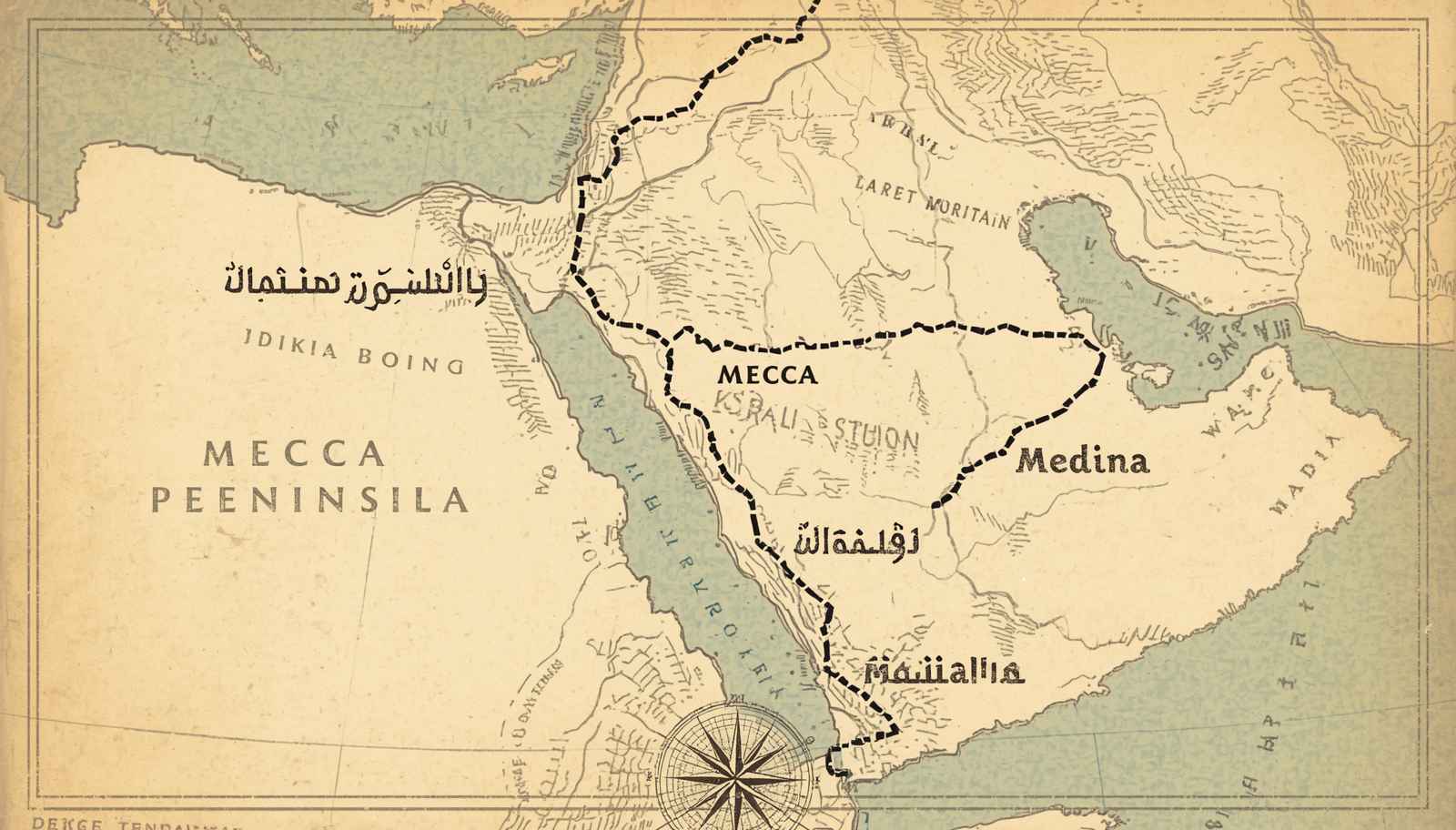
By the early 620s, Muhammad and his followers had spent over a decade in Mecca facing increasing hostility from the city’s powerful merchant clans, who saw Muhammad’s monotheistic message as an economic and political threat to the polytheistic trade culture centered on the Kaaba. Early Muslims — particularly those from lower social classes, including freed slaves — faced ridicule, economic boycott, and in some cases, physical persecution. The situation grew dangerous enough that Muhammad first sent a group of followers to seek refuge in Abyssinia (modern Ethiopia), a Christian kingdom, where the king — known to Islamic sources as Negus Ashama — offered them protection. That earlier migration is sometimes called the First Hijra.
The migration to Medina in 622 CE is the Great Hijra — the one that defined the Islamic calendar. Muhammad departed Mecca quietly, accompanied initially by his close companion Abu Bakr, and traveled approximately 300 miles north to the city then called Yathrib, later renamed Medina, meaning “the city.” He had been invited there by tribal leaders who needed a respected figure to mediate their long-running conflicts.
What unfolded after his arrival was historic. Muhammad established the Constitution of Medina, a document that defined a multi-tribal, multi-religious community — including Jewish tribes — under a shared civic framework. It declared religious freedom, allocated communal responsibilities, and created, for the first time in Islamic history, a structured community of faith. Islam moved from being a persecuted minority movement in Mecca to a functioning society in Medina.
The muhajirun — the “migrants,” those who made the journey with Muhammad — were among the most honored figures in early Islamic memory, praised in the Quran for the sacrifice their departure required. Their counterparts in Medina, the ansar (helpers), who welcomed and supported the migrants, became equally celebrated. Together, these two groups formed the nucleus of what Muslims call the Ummah — the global community of faith.
Christians reading this account may sense a familiar shape to the story. The Israelites’ Exodus from Egypt, Abraham’s call to leave Ur of the Chaldeans (Genesis 12:1), and the early Christian communities scattered by persecution (Acts 8:1–4) all follow the same structural narrative: displacement under pressure, a faithful departure, and the birth of something new on the other side. That parallel does not make the stories identical — they are theologically distinct — but it does make the Hijra recognizable to anyone shaped by the biblical tradition of a God who works through journeys.
How the Hijra Became the Foundation of the Islamic Calendar
The Islamic calendar — technically called the Hijri calendar or Lunar Hijri calendar — does not begin with a cosmic event or the birth of a prophet. It begins with a community in motion. That choice says something significant about Islamic theology: the defining moment of Islamic history is not a miraculous sign in the sky but a people’s act of faith under pressure.
The calendar was not formally established until the reign of the second Caliph, Umar ibn al-Khattab, roughly sixteen years after the Hijra itself. Faced with the practical need for a standardized dating system, Umar and his advisors consulted extensively before settling on the year of the Hijra as Year 1. They did not choose the year of Muhammad’s birth, nor the year the first Quranic revelation came in the Cave of Hira. They chose the year the Muslim community took shape as a living, organized society.
The Hijri calendar is lunar, meaning it tracks the cycles of the moon rather than the sun. Each lunar year is approximately 354 days — about eleven days shorter than the Gregorian solar year. This is why Islamic dates rotate through the Gregorian calendar each year rather than falling on the same date annually. Muharram — the first month of the Islamic year — moved earlier each year, and in 2026 the new Islamic year (1448 AH) begins on approximately June 16.
When you understand this, several things about Muharram fall into sharper focus. Muharram is the first month of the Islamic year because the Islamic year begins when the Hijra began — at the point of departure, the moment of trusting God enough to leave everything behind. Every new Islamic year is, in a sense, a liturgical re-enactment of that act of faith. To understand Muharram fully, you need to understand the Hijra — they are the same story, told in two different forms.
If you want the full picture of why Muharram holds such deep spiritual weight in Islam, the pillar page — [What Is Muharram in Islam?] — covers the entire month, its sacred status, and all of its observances in one place.
The Spiritual Dimension of the Hijra: More Than a Historical Journey of Hijra Meaning in Islam
Most explanations of the Hijra stop at history, dates, geography, and political consequences. But the Hijra carries an interior meaning that practicing Muslims have drawn on for centuries, and that meaning is worth understanding on its own terms.
Early Islamic scholarship identified a spiritual Hijra — the inner migration from sin, selfishness, and spiritual stagnation toward God-consciousness and moral renewal. A hadith attributed to Muhammad draws a direct line between the outward and inward journey: “The true emigrant (muhajir) is the one who abandons what God has forbidden.” In other words, the spirit of the Hijra is not limited to 622 CE. It is a repeating spiritual posture — the willingness to leave behind what harms you and your relationship with God, even when departure is costly.
This dimension of Hijra spiritual meaning is precisely what makes the concept interesting to Christians beyond its historical importance. Scripture is full of this same pattern. Abraham left his homeland not knowing where he was going, trusting God’s call over the familiar (Hebrews 11:8). The Apostle Paul described his own spiritual transformation as a kind of death and resurrection — a leaving behind of everything he had been (Philippians 3:7–9). Repentance in Christian theology carries this same structure: turning away, breaking old associations, committing to a new direction.
None of this is to suggest that Islam and Christianity teach the same thing. They do not. But it does mean that when a Christian encounters the concept of Hijra, they are not entering completely foreign territory. The theological instinct — that genuine faith sometimes requires a hard departure — is one both traditions recognize from different vantage points.
What believers are asking today, as interest in interfaith understanding deepens across American communities, is not whether these traditions are identical, but whether they can be understood. The spiritual meaning of the Hijra offers exactly that kind of entry point.
The Hijra and Muharram: How They Connect
Muharram and the Hijra are not two separate topics that happen to appear on the same calendar. They are bound together by the logic of how the Islamic year was constructed.
Muharram is the first of the twelve months in the Hijri calendar. The word itself means “forbidden” or “sacred” — it is one of four months in Islam during which conflict is traditionally prohibited, a time set apart for spiritual reflection and peace. Because the Islamic year begins with Muharram, and because the Islamic year is rooted in the Hijra, the arrival of Muharram each year carries the memory of that original departure — the community that left Mecca, crossed the desert, and built something new.
There is a secondary layer as well. The tenth day of Muharram is called Ashura, and it holds its own complex history and meaning — observed differently by Sunni and Shia Muslims, touching on the story of Moses, Noah, and in the Shia tradition, the martyrdom of Husayn ibn Ali. To understand how Muslims observe Ashura is to go deeper still into Muharram’s significance — and that fuller story deserves its own page. But none of that depth exists without the Hijra as its foundation.
The Hijra is, in the most direct sense, why Muharram is the first month. The Islamic year does not begin with an astronomical calculation or a harvest season. It begins with a memory — the memory of a people who trusted God enough to walk away from everything they knew and build something better. For Christians who have learned to mark time by Advent and Easter, by Lent and Pentecost, this idea of time structured around a formative act of faith is not unfamiliar. It is, in fact, one of the deeper structural similarities between how these two traditions treat the calendar.
PHASE 6 — FAQ SECTION
Q: What does Hijra mean in simple terms?
A: Hijra is an Arabic word meaning migration or departure. In Islam, it specifically refers to the Prophet Muhammad’s journey from Mecca to Medina in 622 CE, made because of persecution in Mecca. The event was so significant that the entire Islamic calendar — called the Hijri calendar — counts its years from this moment. Dates in the Islamic system carry the label AH, standing for Anno Hegirae, which is Latin for “in the year of the Hijra.”
Q: Why is the Hijra so important in Islam?
A: The Hijra marks the moment Islam transitioned from a small persecuted community into an organized society. In Medina, Muhammad established the first Muslim community with a written constitution, creating a framework for both faith and civic life. Islamic scholars regard this not just as a historical event but as the foundational act of the Ummah — the global Muslim community. It is so central that the Islamic calendar begins its count from this year, not from Muhammad’s birth or the first Quranic revelation.
Q: What is the difference between the Hijra and Muharram?
A: The Hijra is the historical event — Muhammad’s migration from Mecca to Medina in 622 CE. Muharram is the first month of the Islamic lunar calendar, which itself was built upon the Hijra as its starting point. Every time Muharram begins, it marks the opening of another Islamic year counted from the Hijra. The two are connected: Muharram is the calendar marker; the Hijra is the reason that the calendar begins where it does.
Q: Did Muhammad migrate to a Christian kingdom first?
A: Yes — before the main migration to Medina, a group of early Muslims fled to Abyssinia (modern Ethiopia), a Christian kingdom, to escape Meccan persecution. Islamic historical accounts describe the Christian king there, known as Negus Ashama, as welcoming and protective of the Muslim refugees. This earlier migration is sometimes called the First Hijra, distinguishing it from the Great Hijra to Medina in 622 CE that became the foundation of the Islamic calendar.
Q: What does AH mean in Islamic years, and how does it relate to CE years?
A: AH stands for Anno Hegirae, Latin for “in the year of the Hijra.” It marks Islamic years the same way BCE and CE mark years in the Gregorian calendar. Year 1 AH corresponds to 622 CE — the year Muhammad migrated to Medina. The Islamic calendar runs slightly shorter than the Gregorian one (about 354 days per year), so the correspondence shifts gradually. In 2026, we are in the Islamic year 1447–1448 AH.
Q: Is there a spiritual meaning to the Hijra beyond the historical event?
A: Yes, and Islamic scholarship has developed this significantly. Early hadith literature describes a spiritual Hijra — an internal migration away from what God forbids and toward righteous living. The physical journey of 622 CE becomes a model for the inner life: the willingness to leave behind harmful habits, relationships, or attitudes in order to draw closer to God. Many Muslims observe the Islamic New Year with this inward reflection in mind, making it less a celebration and more a moment of quiet recommitment to their faith.
Related posts: