
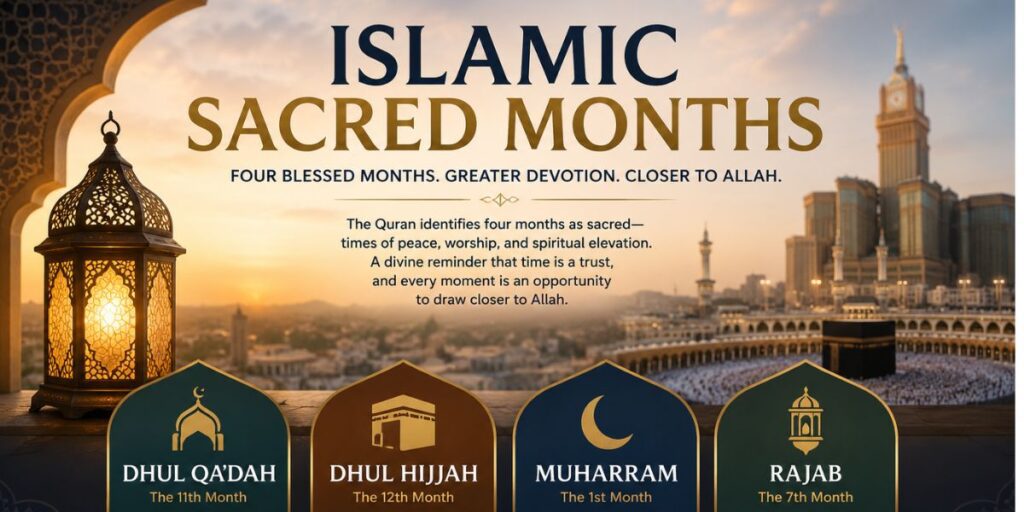
Introduction Paragraph — “Islamic Sacred Months”
Every major faith tradition recognizes that time is not just a measurement — it is a vessel. Islam is no different. Within the Islamic lunar calendar, God designates four months as spiritually elevated above all others: Dhul Qa’dah, Dhul Hijjah, Muharram, and Rajab. These are the Islamic sacred months — periods when the Quran calls believers to heightened moral awareness, increased devotion, and deliberate restraint from wrongdoing.
As someone who has spent years studying comparative religious practice and interfaith dialogue, I can tell you that non-Muslim readers — particularly Christians in America — often find genuine resonance here. The instinct to honor holy seasons is not foreign to anyone raised in a faith that observes Advent or Lent. What changes is the calendar, the theology, and the specific practices. What remains constant is the conviction that God ordains sacred time — and that how we spend it reveals what we truly believe.
What Are the Four Sacred Months in Islam?
The four Islamic sacred months are Dhul Qa’dah, Dhul Hijjah, Muharram, and Rajab. These are not ordinary months on the Islamic lunar calendar — they are explicitly identified in the Quran as months God has consecrated. The Quran states in Surah At-Tawbah (9:36): “Indeed, the number of months with Allah is twelve lunar months in the register of Allah from the day He created the heavens and the earth; of these, four are sacred.”
Three of these months — Dhul Qa’dah, Dhul Hijjah, and Muharram — fall consecutively, back to back. The fourth, Rajab, stands alone in the middle of the Islamic year. This arrangement is theologically significant: the consecutive trio surrounds the Hajj pilgrimage season, the annual journey to Mecca that is one of Islam’s Five Pillars. The isolation of Rajab in the calendar creates a second, mid-year moment of sacred pause.
The Arabic word for these months is Al-Ashhur Al-Hurum, which translates roughly as “the forbidden months” or “the sacred months.” The word haram here carries the meaning of “inviolable” or “protected” — the same root as the word used for the Grand Mosque in Mecca (Al-Masjid Al-Haram). These months are protected — from sin, from conflict, from spiritual carelessness. For a Christian reader, a rough comparison might be the way Advent or Lent functions: a season when the normal pace of life is meant to slow and spiritual attention sharpens. The scale and theological mechanics differ, but the instinct — God-ordained holy time — is deeply familiar.
Why Does Islam Have Sacred Months? The Theological Root
The idea that certain times carry greater spiritual weight is older than Islam itself. Sacred time is woven into the fabric of monotheistic faith. Christians recognize this when they read Leviticus 23, where God gives Israel an entire calendar of appointed feasts — times God called moedim, meaning “appointed meetings.” Psalm 104:19 acknowledges that God made the moon “to mark the seasons.” Sacred months in Islam carry this same ancient conviction: time is not morally or spiritually neutral.
In Islamic theology, the sacred months in the Quran carry elevated moral significance. Sin committed during these months is understood to carry greater weight — not because God is more severe, but because breaking a consecrated boundary demonstrates a deeper kind of spiritual recklessness. Conversely, acts of worship, charity, and restraint performed during the holy months in Islam are believed to carry amplified reward. This creates a theological incentive structure that shapes Muslim devotion rhythmically through the year.
The pre-Islamic Arab world also observed these months as times of peace — a ceasefire tradition called the “truce of God” that predates the Quran’s revelation. Islam retained and sanctified this tradition, giving it theological grounding rather than merely tribal agreement. What was once a practical arrangement for safe travel to trade fairs became, under Islam, a divine command rooted in justice and human dignity. This layer of history is one that competitors rarely mention — and it matters, because it shows how Islam absorbed and elevated existing moral traditions, much as early Christianity reshaped Roman and Hebrew cultural practices by giving them theological meaning.
The Four Sacred Months Individually: Names, Meanings, and Significance
Each of the four sacred months Islam recognizes has its own character and associated observances, and understanding each one individually gives far more depth than a simple list.
Dhul Qa’dah — the 11th month of the Islamic lunar calendar — is named from an Arabic root meaning “to sit” or “to rest.” Historically, this was a month when Arabs ceased warfare and travel-related conflict, creating a protected corridor for pilgrims beginning their journey toward Mecca. For Muslims today, it remains a month of heightened self-restraint, particularly in speech and interpersonal conflict.
Dhul Hijjah — the 12th month — is arguably the most spiritually dense of the four. It contains the annual Hajj pilgrimage, the Feast of Sacrifice (Eid al-Adha), and the first ten days, which Islamic teaching considers among the most spiritually valuable days of the entire year. The Prophet Muhammad reportedly said that no days of good deeds are more beloved to God than these ten days. Dhul Hijjah is not just a sacred month in name — it is a sustained season of communal and individual worship.
Muharram — the first month of the Islamic year — carries the distinction of being the only month God directly calls sacred in the Quran with specific linguistic emphasis. It includes the fast of Ashura on the 10th day, observed by Muslims as a day of fasting in gratitude for Moses’s deliverance from Pharaoh — a tradition with a direct and moving parallel for Christian readers who revere that same Exodus story. If you want to understand Muharram more deeply, the dedicated article on What Is Muharram in Islam explores this month in full detail.
Rajab — the 7th month — stands apart from the others both in its calendar position and its spiritual character. It is associated in Islamic tradition with the Prophet Muhammad’s Night Journey (Al-Isra wal Mi’raj), a miraculous spiritual journey that holds enormous significance in Islamic theology. Rajab is a month that many Muslims use for increased voluntary fasting and prayer in preparation for Ramadan, which follows two months later.
For Christian readers who want to understand the deeper meaning of fasting and commemoration during Muharram specifically, the article on the significance of Ashura offers a focused and accessible look at one of Islam’s most spiritually significant days.
How Islamic Sacred Months Compare to Christian Holy Seasons
This is the question most Christian readers are quietly carrying, and it deserves a direct, honest answer rather than a vague “all religions are basically the same” response — because they’re not, and real respect means engaging with actual differences.
Christian holy seasons like Advent, Lent, Holy Week, and Pentecost operate within a solar calendar tied to historical events in Jesus’s life. The spiritual rhythm is largely narrative — Advent anticipates the Incarnation, Lent traces the path to the Cross, and Easter celebrates the Resurrection. Sacred time in Christianity is shaped primarily around what God did in history.
Islamic sacred months operate within a lunar calendar that shifts roughly 11 days earlier each solar year, meaning they cycle through all seasons over a 33-year period. They are not tied to narrative events in the same sequential way. Instead, they are designated as sacred by God’s direct command, elevated by their connection to acts of worship (particularly Hajj), and observed as periods of heightened moral accountability.
The counterintuitive insight here — one competitors completely miss — is that the functional experience of sacred months may feel more similar to Christian observance than the theological mechanics suggest. A Christian keeping a Lenten fast and a Muslim observing voluntary fasts during Rajab are both doing something fundamentally similar: choosing, within a designated sacred season, to limit something physical in order to create space for something spiritual. The outer forms differ. The interior movement — toward God, through discipline — is recognizable across both traditions.
In 2026, as interfaith dialogue continues growing across American communities, more Christians are finding that understanding Islamic sacred time deepens their own appreciation for the rhythm of Christian liturgical seasons. Knowing that another tradition also structures the year around God-ordained holy time affirms what Ecclesiastes 3:1 expresses so simply: “There is a time for everything, and a season for every activity under the heavens.”
What Is Forbidden During the Sacred Months?
The forbidden months Islam designates carry a specific moral structure that is worth understanding clearly. The primary prohibition is against initiating aggression or warfare. In the pre-Islamic Arab world, these months were enforced truces. In Islamic theology, God elevated this social contract into a divine command: starting conflict during sacred months is a particularly grave transgression.
Beyond the prohibition on warfare, Islamic teaching extends this principle inward. Sin in general — gossip, cruelty, dishonesty, violence of any kind — carries greater moral weight during the haram months. This isn’t a unique-to-Islam concept. Christians familiar with Paul’s letter to the Ephesians hear a similar principle when he writes in Ephesians 5:15-16: “Be very careful, then, how you live — not as unwise but as wise, making the most of every opportunity.” Sacred seasons are, in both traditions, opportunities to make the most of elevated spiritual time.
It’s worth noting what is not forbidden: normal daily life, work, commerce, and celebration. The sacred months are not periods of withdrawal from the world but of heightened intentionality within it. A Muslim during Dhul Hijjah still works, still raises children, still engages neighbors — but with a heightened awareness that this season calls for extra moral care. This balance of sacred time within ordinary life is something many American Christians find deeply relatable, particularly those who observe Lent while maintaining full professional and family lives.
Why Sacred Time Still Matters — For Muslims and Christians Alike in America
Here is something worth saying plainly: the concept of sacred time is under quiet pressure in 21st-century American life. A 24/7 digital economy, always-on connectivity, and the erosion of shared cultural rhythms have made it harder for people of any faith to observe holy seasons meaningfully. What many believers are asking today — across traditions — is not just what their sacred seasons mean theologically, but how to actually live them in a culture that doesn’t pause for them.
For American Christians reading this, understanding that Muslims navigate this same tension is both humbling and encouraging. A Muslim family trying to observe the spiritual depth of Dhul Hijjah while managing work deadlines and school schedules faces the same friction a Christian family feels trying to keep Advent quiet in December while the culture pushes relentless commercial noise. The struggle to honor sacred time against cultural pressure is, genuinely, shared ground.
Recent observations from interfaith community leaders across the United States note that when Christians and Muslims share honest conversations about their respective holy seasons, mutual respect deepens more quickly than through almost any other topic. Sacred time is intimate. It reveals what a person actually values. When Christians learn that their Muslim neighbors treat certain months as morally elevated — when they understand that a Muslim saying “it’s Dhul Hijjah” is communicating something like “I’m trying to live more carefully right now” — the humanity in that is immediately recognizable.
The Biblical call to observe sacred time runs from Genesis through Revelation. From the Sabbath principle in Exodus 20 to the appointed feasts of Leviticus to the Psalmist’s declaration that “this is the day the Lord has made” — Scripture consistently affirms that God hallows time. Understanding how another major world faith practices the same conviction, in its own theologically distinct way, can deepen a Christian’s appreciation for why their own holy seasons exist.
PHASE 6 — FAQ SECTION
Q: What are the four sacred months in Islam?
A: The four sacred months in Islam are Dhul Qa’dah, Dhul Hijjah, Muharram, and Rajab. These months are designated as sacred in the Quran (9:36). Three fall consecutively around the Hajj pilgrimage season, while Rajab stands alone in the middle of the Islamic year. During these months, Muslims are called to heightened moral discipline, increased worship, and avoidance of conflict and sin.
Q: Is Ramadan one of the sacred months?
A: No, Ramadan is not among the four sacred months. The four are Dhul Qa’dah, Dhul Hijjah, Muharram, and Rajab. Ramadan is a separate, distinctly significant month — the month of obligatory fasting and the revelation of the Quran to the Prophet Muhammad. While Ramadan carries immense importance, it belongs to a different theological category than the four Quranic sacred months.
Q: What does “forbidden” mean in the context of Islamic sacred months?
A: “Forbidden” in this context means the months are inviolable — protected from warfare, aggression, and heightened sin. The Arabic term haram (as in Al-Ashhur Al-Hurum) carries the meaning of “sacred” and “protected,” not simply “prohibited.” Muslims understand these months as times when the moral stakes of actions are elevated — good deeds earn greater reward, and wrongdoing carries greater weight before God.
Q: Do Muslims do anything special during the sacred months?
A: Yes. During the sacred months, Muslims increase voluntary prayer, fasting, charity, and self-examination. Dhul Hijjah includes the Hajj pilgrimage and Eid al-Adha. Muharram includes the voluntary fast of Ashura. Rajab is often used for spiritual preparation before Ramadan. While none of these months requires specific rituals as obligations (except Hajj during Dhul Hijjah for those who are able), they are widely treated as opportunities for deeper devotion.
Q: How do Islamic sacred months relate to the Hajj pilgrimage?
A: Three of the four sacred months — Dhul Qa’dah, Dhul Hijjah, and Muharram — directly surround the Hajj pilgrimage. Dhul Qa’dah is when pilgrims begin their journey. Dhul Hijjah is when Hajj itself takes place, culminating on the Day of Arafah and Eid al-Adha. Muharram follows as a time of continued sacred reflection. The pilgrimage season is both the historical reason these months carry extra protection and their ongoing spiritual anchor.
Q: Why should Christians care about Islamic sacred months?
A: Understanding Islamic sacred months helps Christians engage respectfully and knowledgeably with Muslim neighbors, colleagues, and friends. Both traditions structure spiritual life around God-ordained holy seasons — Advent and Lent in Christianity, the sacred months in Islam. Recognizing this shared instinct for sacred time creates genuine common ground for conversation. In a country as diverse as the United States, this kind of informed respect is both practically useful and spiritually enriching.
Related posts: