
Introduction:
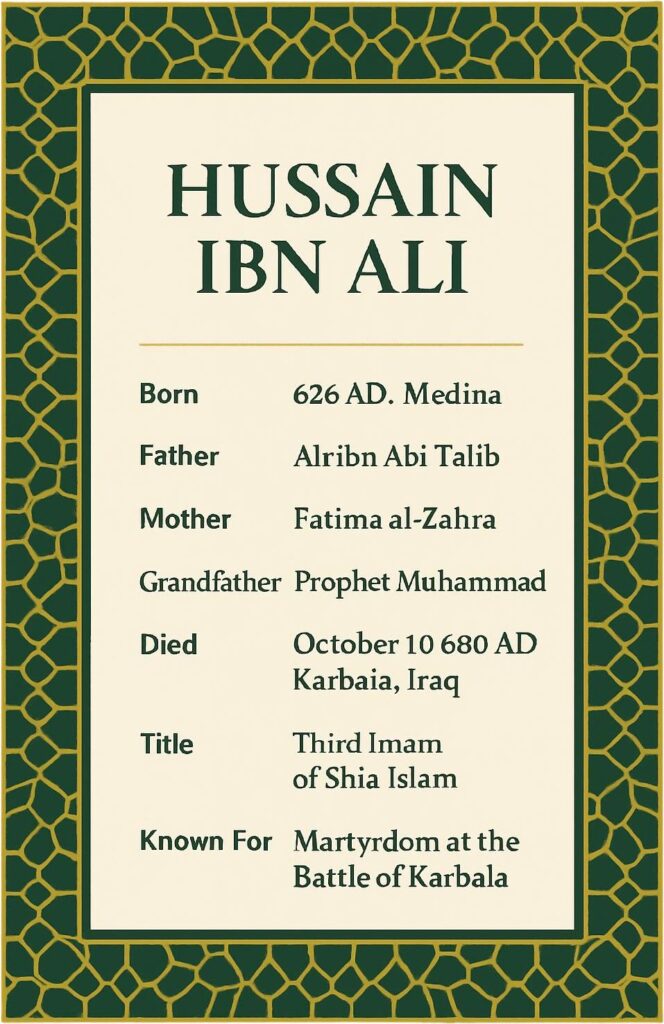
Imam Hussain ibn Ali was the grandson of Prophet Muhammad (S.A.W) and one of the most morally significant figures in all of human history — not just Islamic history. Born in 626 AD in Medina, he was raised in the household of the Prophet himself, shaped by values of justice, compassion, and uncompromising faith. In 680 AD, he stood on the plains of Karbala in modern-day Iraq with only 72 companions, facing an army thousands strong sent by the corrupt ruler Yazid I.
He refused to pledge allegiance to tyranny. He was killed for that refusal. That single act of moral courage — choosing death over the endorsement of injustice — transformed the course of Islamic history and continues to inspire Muslims, Christians, and people of no faith alike, more than 1,300 years later. What he stood for was never complicated: truth matters more than survival.
Who Was Imam Hussain? The Basic Answer
Hussain ibn Ali — also written as Imam Hussain, or al-Husayn — was born in 626 AD in Medina (present-day Saudi Arabia). He was the son of Ali ibn Abi Talib (the fourth caliph of Islam) and Fatima al-Zahra (the daughter of Prophet Muhammad). That lineage matters enormously: it made Hussain the direct grandson of the Prophet Muhammad, the founder of Islam.
He had an older brother, Imam Hasan, and both brothers were described by the Prophet himself as “the leaders of the youth of Paradise.” To Muslims of all backgrounds, Hussain was raised in arguably the most spiritually significant household in Islamic history.
For Christians reading this, consider the closest parallel you have: a man of pure lineage, raised in a house of prophets, committed from childhood to God’s truth, destined for a confrontation with power that would end in violent death — and whose sacrifice would reshape the consciousness of a civilization.
That is essentially the story of Imam Hussain.
He was not a distant scholar or a political strategist. He was a man known for his mercy, his patience, his generosity, and — above all — his refusal to bend his conscience to power. He lived quietly for decades before history forced his hand. When it did, he faced it with a clarity that has never quite been replicated.
The World Hussain Was Born Into
To understand Imam Hussain’s history, you need to understand the political turbulence of early Islam. Prophet Muhammad (S.A.W) died in 632 AD, and the question of who would lead the Muslim community — the ummah — immediately fractured into competing camps.
A series of caliphs led the growing Muslim empire. By 661 AD, Muawiya I — the founder of the Umayyad Dynasty — had consolidated power. Muawiya was politically shrewd but also known for prioritizing dynastic power over spiritual integrity. He ruled for nearly two decades.
The pivotal problem came when Muawiya appointed his own son, Yazid I, as his successor. This was, by any measure, a dramatic departure from the early Islamic ideal of leadership chosen by merit and community consultation. Yazid was widely regarded — even by many of his contemporaries — as openly immoral: known for drinking wine, ignoring religious obligations, and governing by fear rather than justice.
Hussain watched this unfold. After Muawiya’s death in 680 AD, Yazid demanded that Hussain pledge his bay’ah — his public oath of allegiance — essentially giving the new caliph religious legitimacy. Without Hussain’s endorsement, Yazid’s rule would lack the moral credibility it desperately needed.
Hussain refused.
That refusal is the hinge of Imam Hussain’s story — and everything that followed flows from it.
Why Hussain Refused: The Moral Logic That Cost Him Everything
It would be a mistake to read Hussain’s refusal as political rebellion. He said so himself, explicitly and repeatedly.
One of Hussain’s most frequently cited statements — made as he left Medina heading toward what he must have sensed was his death — was this:
“I have not risen to spread evil or to show off, nor for corruption or oppression. I have risen to seek reform in the community of my grandfather.”
He wasn’t reaching for power. He was protecting truth. In Hussain’s understanding, pledging allegiance to Yazid would be an endorsement of corruption — not just politically, but spiritually. It would signal to the Muslim world that the highest religious figure of his lineage approved of a man who had hollowed out the moral core of Islam.
He could not do it.
There’s something here that Christians will immediately recognize — the moment when a righteous person is asked to publicly affirm something they know to be false. When Peter denied Jesus three times to save himself, it became one of the most painful moments in the Gospel narrative. Hussain faced the same pressure, and he made the opposite choice.
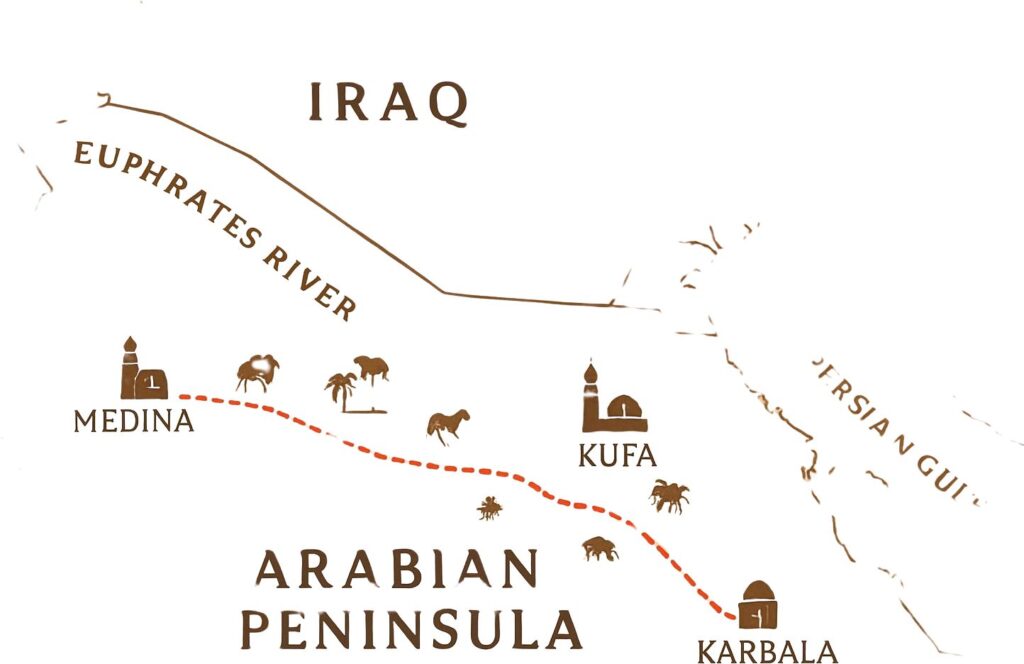
He left Medina. He refused to give that allegiance. And he began the journey toward Karbala.
The Road to Karbala: A Journey Without Return
Word had reached Hussain from the city of Kufa in modern-day Iraq. The people there — tens of thousands of them — had sent letters. Thousands of letters, reportedly. They wanted Hussain to come. They promised him their support and loyalty. They were ready to stand with him against Yazid.
Hussain sent his cousin Muslim ibn Aqeel to Kufa to verify the situation. The reports came back positive: the people of Kufa were ready.
So Hussain gathered his family and a small group of companions — 72 people in total, including women, children, and elderly. He set out on the road toward Kufa, believing that a city was waiting for him.
What he didn’t yet know was that Yazid’s governor, Ubaydullah ibn Ziyad, had already crushed the movement in Kufa through threats and fear. By the time Hussain’s caravan was intercepted on the plains near the Euphrates River, the Kufans who had promised support had either been imprisoned, killed, or had quietly abandoned their oaths.
The land was called Karbala — from the Arabic words meaning “affliction” and “trial.” The name would never be forgotten.
The Battle of Karbala: October 10, 680 AD
What happened at Karbala on the 10th of Muharram in the year 61 AH — corresponding to October 10, 680 AD — was not, by military standards, much of a battle. It was a massacre.
On one side: Hussain ibn Ali, his family, and 72 companions. Among them were his sons, his nephews, elderly men, and devoted friends. Women and children waited in tents behind the small group of fighters.
On the other side: an army sent by Yazid I — estimated by various historians at anywhere from 4,000 to 30,000 men.
Before the fighting began, Yazid’s forces enacted a cruel tactic: they cut off Hussain’s caravan from the Euphrates River on the 7th of Muharram. For three days before the battle, Hussain’s group — including infants and young children — had no access to water.
Hussain still offered peaceful solutions. He asked for three options: let them return to Medina, let them go to the frontier to fight for Islam, or let him meet Yazid directly to resolve things. Every option was refused.
On the morning of Ashura, after the night prayer, Hussain addressed his companions and released them from any obligation to stay. He told them to leave, take his family members, and go to safety. It was dark. They could disappear. No one would stop them. He explicitly told them that the army’s quarrel was only with him.
Not one companion left.
One by one, over the course of that terrible day, Hussain’s companions and family members were killed. His half-brother Abbas ibn Ali — the flag-bearer, a man of legendary courage — was killed trying to bring water for the children. His son Ali al-Akbar, eighteen years old and bearing a striking resemblance to Prophet Muhammad, was killed in combat. His infant nephew Ali al-Asghar — a baby, still nursing — was killed by an arrow while Hussain held him up asking for even a few drops of water for the child.
By the afternoon, Hussain ibn Ali stood alone.
He was wounded in many places. He had watched every man who loved him die. He still fought. He fell from his horse — some accounts say due to wounds, others describe him continuing even then. And he was killed. His head was separated from his body. The women and remaining children of the Prophet’s family were taken as captives.
The Umayyad army had its military victory. History would decide who actually won.
What Hussain’s Death Meant — And Why It Still Resonates
Here is what’s remarkable about the legacy of Imam Hussain: it transcended the event almost immediately.
Yes, there was grief — overwhelming, civilization-shaping grief among those who loved him. That grief became Ashura, the annual day of mourning commemorated by Shia Muslims every year on the 10th of Muharram. It involves weeping, prayer, processions, and acts of remembrance that have continued without interruption for 1,344 years.
But the resonance went further than mourning. Hussain’s stand at Karbala became a permanent moral reference point. In the Islamic world, whenever a population faced tyranny, corruption, or oppression, they reached for Hussain’s name. His example answered a question every generation must ask: when power demands your conscience, what do you do?
Hussain answered it at the cost of everything.
The 18th-century British historian Thomas Carlyle wrote: “The best lesson which we get from the tragedy of Karbala is that Hussain and his companions were the rigid believers of God.”
The Indian nationalist Mahatma Gandhi — a Hindu — said: “I learned from Hussain how to achieve victory while being oppressed.”
And Charles Dickens, the great Christian novelist, reportedly wrote: “If Husain had fought to quench his worldly desires, then I do not understand why his sister, wife, and children accompanied him. It stands to reason therefore, that he sacrificed purely for Islam.”
These are not Muslim voices. They are people from entirely different traditions who looked at Imam Hussain’s story and recognized something universal.
What Christians Can See in Hussain’s Story
This is the section many people come here for — and it deserves careful, honest treatment.
There are real theological differences between Christianity and Islam. The role of Jesus in Christian faith — his divinity, his resurrection, the doctrine of atonement — has no direct parallel in how Muslims understand Hussain. These differences should not be erased or glossed over. They are real and they matter.
But within those differences, there are deep structural and moral resonances that are genuinely striking.
A Christian scholar at an Islamic interfaith conference once put it this way: “Among the Jews, the figure of Job; among Christians, the person of Jesus; and among the people.
Consider the parallels honestly:
The innocent man who dies rather than compromise truth. Jesus is arrested in Gethsemane knowing what is coming. Hussain leaves Medina knowing, by most accounts, that there is no military victory waiting for him. He submits to what he understands as God’s will for his life.
The voluntary nature of the sacrifice. Jesus says in John 10:18, “No one takes my life from me, but I lay it down of my own accord.” Hussain, the night before Karbala, explicitly releases every companion from obligation. He makes his choice freely, knowing full well the alternative.
The suffering of innocents alongside the righteous figure. Christians meditate not only on the death of Jesus but on his mother’s grief, the disciples’ anguish, the community’s devastation. At Karbala, the suffering of Zainab — Hussain’s sister — the captivity of children, the murder of an infant: these are not incidental to the story. They are part of its moral weight.
The corrupted authority demanded submission. The Pharisees and Roman authorities demand that Jesus either recant or accept execution. Yazid’s government demands that Hussain endorse corruption or face death. In both cases, the righteous figure refuses. In both cases, the worldly authority “wins” the immediate confrontation.
The redemptive power of suffering. In Christian theology, Jesus’ suffering is redemptive — it transforms the world. In Shia theology, Hussain’s suffering carries a similarly cosmic significance. The scholar Mahmoud Ayoub has noted that both traditions “accept a mediator between God and man, one whose essential being and place in human history plays a determining role.”
The Lebanese Christian author Antoine Bara spent years studying this and wrote the book Hussain in the Christian Ideology — later translated into 17 languages and accepted for graduate study at five universities. His conclusion was not that Hussain was Jesus, or that the stories are theologically equivalent. His conclusion was that Hussain represents a moral archetype — the righteous martyr who chooses truth at total personal cost — that every tradition of faith recognizes because it points toward something true about the human condition.
That recognition matters. It’s not syncretism. It’s the honest acknowledgment that God places certain patterns in history, and that sometimes those patterns appear across more than one tradition.
The Family Behind the Man: Who Were the Ahlulbayt?
To understand Imam Hussain fully, you need to know his family — the Ahlulbayt, a term meaning “People of the House” (of the Prophet). In Islamic theology, this refers to Prophet Muhammad’s immediate family: his daughter Fatima al-Zahra, her husband Ali ibn Abi Talib, and their children Hasan and Hussain.
For Christians, think of the Ahlulbayt the way you might think of the Holy Family — a household chosen for a specific divine purpose, marked by extraordinary character and suffering.
Fatima al-Zahra — Hussain’s mother — was described by the Prophet as “the leader of the women of Paradise.” She died young, only months after her father. Hussain grew up motherless, shaped by the grief of that early loss.
Ali ibn Abi Talib — Hussain’s father — was the Prophet’s cousin, his son-in-law, and the fourth caliph. He was one of the first Muslims, renowned for his scholarship, his justice, and his warrior’s courage. He was assassinated in 661 AD while praying.
Imam Hasan — Hussain’s older brother — became the second Imam of Shia Islam after Ali’s death. He pursued a peace treaty with Muawiya to prevent further Muslim bloodshed. He died in 670 AD, some accounts suggesting he was poisoned.
By the time Imam Hussain faced Yazid’s demand for allegiance, he had already lost his grandfather, his mother, his father, and his brother. He had watched the world his family built be dismantled piece by piece. His refusal at Karbala was not the impulsive act of an angry man. It was the considered decision of someone who had spent a lifetime watching what compromise with corruption produced.
The Role of Zainab: The Woman History Almost Forgot
One of the most overlooked aspects of Imam Hussain’s story is the role of his sister Zainab bint Ali. She survived Karbala. And her survival may be as historically significant as Hussain’s martyrdom.
After the battle, the women and children of the Prophet’s family were taken as captives, marched to Kufa and then to Damascus — Yazid’s capital. They were paraded publicly. Yazid expected humiliation. What he got was the opposite.
Zainab delivered speeches in Kufa and before Yazid’s court that are among the most powerful recorded in early Islamic history. In front of the man who had just killed her brother, her nephews, and her family — a man with an army and absolute political power — she stood and declared, with complete composure, that history would condemn him.
She was right.
For Christians who know their scripture, the image is strikingly familiar. In John 19, Mary stands at the foot of the cross. She does not flee. She does not recant. She witnesses. Zainab’s presence at Karbala — and her subsequent witness — served much the same function: ensuring that the truth of what happened could not be erased by the powerful.
In fact, many Islamic scholars argue that without Zainab’s speeches and testimony, the full story of Karbala would have been suppressed by the Umayyad state. She carried the message when no one else could.
Ashura: The Annual Day of Remembrance
Every year, on the 10th of Muharram — the first month of the Islamic lunar calendar — hundreds of millions of Shia Muslims around the world observe Ashura. In cities from Baghdad to London to New York, processions fill the streets. Elegies are sung. Sermons are delivered. Tears flow freely.
For people outside the tradition, this can be startling. Why would a religion center such elaborate annual mourning around an event 1,300+ years in the past?
The answer, once you understand it, makes complete sense — and Christians especially may find it familiar.
The Christian Holy Week — Palm Sunday through Good Friday to Easter — is not treated as “old news” from two thousand years ago. It is re-lived, re-entered, grieved, and celebrated annually because the events themselves are understood to carry permanent spiritual meaning. The crucifixion happened once in history. But its truth is encountered again every year in every person who genuinely engages with it.
Ashura works similarly. The events of Karbala happened in 680 AD. But for Shia Muslims, Hussain’s choice — to give everything rather than endorse injustice — is not a historical curiosity. It is a living moral reality. Every generation must decide: where do I stand when power demands my silence?
The mourning of Ashura is not depression or despair. It is — as those who observe it will tell you — clarifying. It reconnects people to their values. It reminds them that some things are worth more than survival.
What Christian Thinkers Have Said About Imam Hussain
This is a dimension of Imam Hussain’s legacy that most Western Christians have never encountered, and it’s genuinely surprising.
George Jordac (1931–2014), a Lebanese Orthodox Christian scholar, wrote extensively on Hussain. His conclusion was that Hussain represented “the highest concepts of life” and that his stand at Karbala demonstrated “what it means to be a human being in the fullest sense.”
Antoine Bara, the Syrian Christian author of Hussain in the Christian Ideology, compared the martyrdom of Hussain to the martyrdom of Jesus and found in both figures the same moral archetype: the one who refuses to save himself at the cost of truth. His book has been translated into 17 languages.
Christopher Clohessy, a Catholic scholar and author of several books on Islamic theology, has written about the similarities between Fatima and Mary — both mothers of martyred sons, both intercessors in their traditions, both figures of quiet grief and immense spiritual authority. He notes that “there are many similarities” between Catholic and Shia theology at the devotional level.
A Christian speaker at an Islamic conference in the United States once observed: “When the suffering of the good person — as in the case of Jesus or Imam Hussain — happens at the hands of evil people, the questions become even sharper. Both ask us: what is the cost of righteousness? Both answer it the same way.”
These are not peripheral figures making fringe observations. They are theologians, historians, and writers who studied Imam Hussain seriously and reported what they found.
Imam Hussain’s Most Powerful Sayings
Hussain’s words have been preserved in Islamic scholarship for over 1,300 years.
On the purpose of his stand: “I have not risen to spread evil or to show off, nor for corruption or oppression.”
These people have adhered to the obedience of the devil and have abandoned the obedience of the Most Merciful.”
On God’s sovereignty: “Whatever God wills, is.”
On the night before Karbala (releasing his companions): “These people want nothing but me.”
For a Christian reader, these statements feel less foreign than you might expect. The insistence that God’s will must be trusted even in the darkest hour, the refusal to equate survival with righteousness, the clarity about what you are fighting for and why — these are not alien moral categories.
The Historical Aftermath: What Karbala Changed
The Battle of Karbala was, militarily, a brief and lopsided engagement. It lasted a single day. Yazid’s forces vastly outnumbered Hussain’s. By any tactical measure, it should have been forgettable.
Instead, it became one of the most consequential events in world history.
In the immediate aftermath, the outrage over Karbala contributed to a series of rebellions against Umayyad rule. Within 70 years, the Umayyad Dynasty was overthrown by the Abbasid Revolution, and historians note that the moral weight of Karbala was a significant catalyst for that revolution. Even those who did not share Shia theology were horrified by what had been done to the Prophet’s family.
More profoundly, Karbala permanently crystallized the Sunni-Shia split in Islam. Shia Muslims trace their identity directly to their belief that the Prophet’s family — beginning with Ali ibn Abi Talib and continuing through Imam Hussain — were the rightful leaders of the Muslim community. Karbala was not just a political defeat. It was the moment that turned grief into doctrine.
For the broader Islamic world, Hussain ibn Ali became — and remains — a permanent moral reference. In Iranian revolutionary politics, in Iraqi tribal loyalties, in the global Shia diaspora, Hussain’s name is invoked whenever a community believes it is facing oppression. His example asks the question every generation must answer: when the powerful demand your silence, do you speak?
Why Imam Hussain Matters in the Modern World
Some figures belong to their century. Others transcend it. Imam Hussain belongs to the second category.
His story resonates in 2025 for the same reason it resonated in 780 or 1880. Human beings still face the question he faced: Is it better to accommodate injustice and survive, or to resist it and suffer? That question has no geographical or religious boundary. It belongs to every tradition and every century.
This is why the Who Is Hussain? global campaign — a non-religious humanitarian initiative inspired by his values — runs charitable drives, social justice projects, and educational outreach in dozens of countries. It operates on a simple premise: Hussain’s choices — to feed people who were hungry, to protect those who were vulnerable, to refuse to endorse what he knew was wrong — describe a kind of human excellence that transcends the boundaries of religion.
Mahatma Gandhi found in Hussain a lesson in moral resistance. Nelson Mandela reportedly quoted Hussain. The Indian poet Rabindranath Tagore wrote of him with admiration.
He chose the truth. He chose God. He chose to protect the integrity of what he believed in, even when the price was everything.
That is a story Christians have heard before. It sounds different in Arabic, it unfolds in a desert in Iraq rather than on a hill outside Jerusalem, and the theological frameworks are distinct. But the moral core — the choice of the righteous martyr who refuses to betray truth — is something every tradition that takes God seriously will recognize.
Frequently Asked Questions
Q: Who was Imam Hussain in simple terms?
Imam Hussain was the grandson of Prophet Muhammad, born in 626 AD in Medina. He was the son of Ali ibn Abi Talib and Fatima al-Zahra. He is most remembered for refusing to pledge allegiance to the corrupt ruler Yazid I, leading to his martyrdom at the Battle of Karbala in 680 AD. He is considered one of the most important figures in Islamic history and a universal symbol of standing against injustice.
Q: Why is Imam Hussain important to Muslims?
For Shia Muslims, Hussain is the third Imam and his martyrdom at Karbala is the central event of their religious identity. For Sunni Muslims, he is respected as the Prophet’s grandson and a martyr. Across the Muslim world, he represents the principle that religious and moral integrity must not be sacrificed for political survival.
Q: What is Ashura and why do people mourn?
Ashura is the 10th day of Muharram (the first month of the Islamic calendar). For Shia Muslims, it marks the day Imam Hussain was killed at Karbala. It is observed annually through mourning gatherings, processions, and prayers. It is not mourning for its own sake — it is annual recommitment to the values Hussain died for: justice, truth, and faith.
Q: How is Imam Hussain similar to Jesus for Christians?
Both figures are understood, within their traditions, as innocent men who chose death rather than compromise truth. Both faced corrupt authority that demanded submission. Both died surrounded by grief and betrayal. Both left behind a legacy that transformed the world far more than any military victory could have. Christian scholars like Antoine Bara and Christopher Clohessy have written seriously on these parallels.
Q: Who was Yazid and why was he so problematic?
Yazid I was the son of Muawiya and became the Umayyad Caliph in 680 AD. He was widely regarded, even in his own time, as immoral and unfit for the position. He demanded Hussain’s public allegiance to legitimize his rule. When Hussain refused, Yazid sent an army to force the issue at Karbala. His name has become, in Islamic tradition, synonymous with oppression and corruption.
Q: Is Imam Hussain mentioned in the Bible?
This is a question some Muslim writers have explored, primarily through thematic and prophetic connections. There is no direct mention by name. However, some scholars draw parallels between Isaiah’s Suffering Servant passages, the mourning prophecies in Zechariah, and the broader biblical theme of the righteous martyr. These comparisons are interpretive, not literal, and Christian readers should approach them with appropriate theological care.
Q: What is the significance of Karbala as a place?
Karbala is a city in modern-day Iraq, located near the Euphrates River. Today it contains the Shrine of Imam Hussain, one of the holiest sites in Shia Islam. Millions of pilgrims visit annually. The city’s name, in Arabic, has been interpreted to mean “affliction” or “trial” — and the plains where the battle occurred in 680 AD remain a place of profound spiritual significance.
Q: Why did the people of Kufa abandon Hussain?
The people of Kufa had sent thousands of letters inviting Hussain and promising support. But before he arrived, the Umayyad governor Ubaydullah ibn Ziyad crushed the movement through threats, imprisonments, and execution of key figures. For Shia Muslims, this abandonment is remembered as one of the great moral failures of Islamic history — and a key reason why the events of Karbala carry such tragic weight.
Final Reflection
Imam Hussain was, by birth, one of the most connected men in the history of Islam. By choice, he was one of the most principled. He had every reason to compromise: political safety, personal survival, the lives of people he loved. He chose instead to stand in the desert and say — simply, completely, at total personal cost — that he would not call evil good.
For Christians, that moral architecture is not foreign. It is the architecture of Golgotha. It is the architecture of every martyr in the tradition who chose conscience over comfort.
You do not have to be Muslim to recognize what Hussain did. You do not have to share his theology to feel the weight of his choice. You only need to take seriously the question his life poses to yours:
When the world demands that you endorse what you know to be wrong, what will you do?
Hussain answered that question with everything he had.
That is why, fourteen centuries later, the world still speaks his name.