Introduction: Parveen Shakir Shayari in Urdu – Her Greatest Verses, Meanings, and a Legacy That Refuses to Fade
In 2026, Parveen Shakir’s shayari is being rediscovered — not in dusty anthologies, but on smartphone screens at 2 a.m., in WhatsApp messages between friends who share a line when words of their own won’t come, in college dormitories where South Asian American students are finding, perhaps for the first time, a poet who sounds exactly like what they feel but could never say. That quiet, powerful rediscovery is exactly what Parveen Shakir deserves. And it tells you something important about what great Urdu shayari actually does: it doesn’t age. It waits.
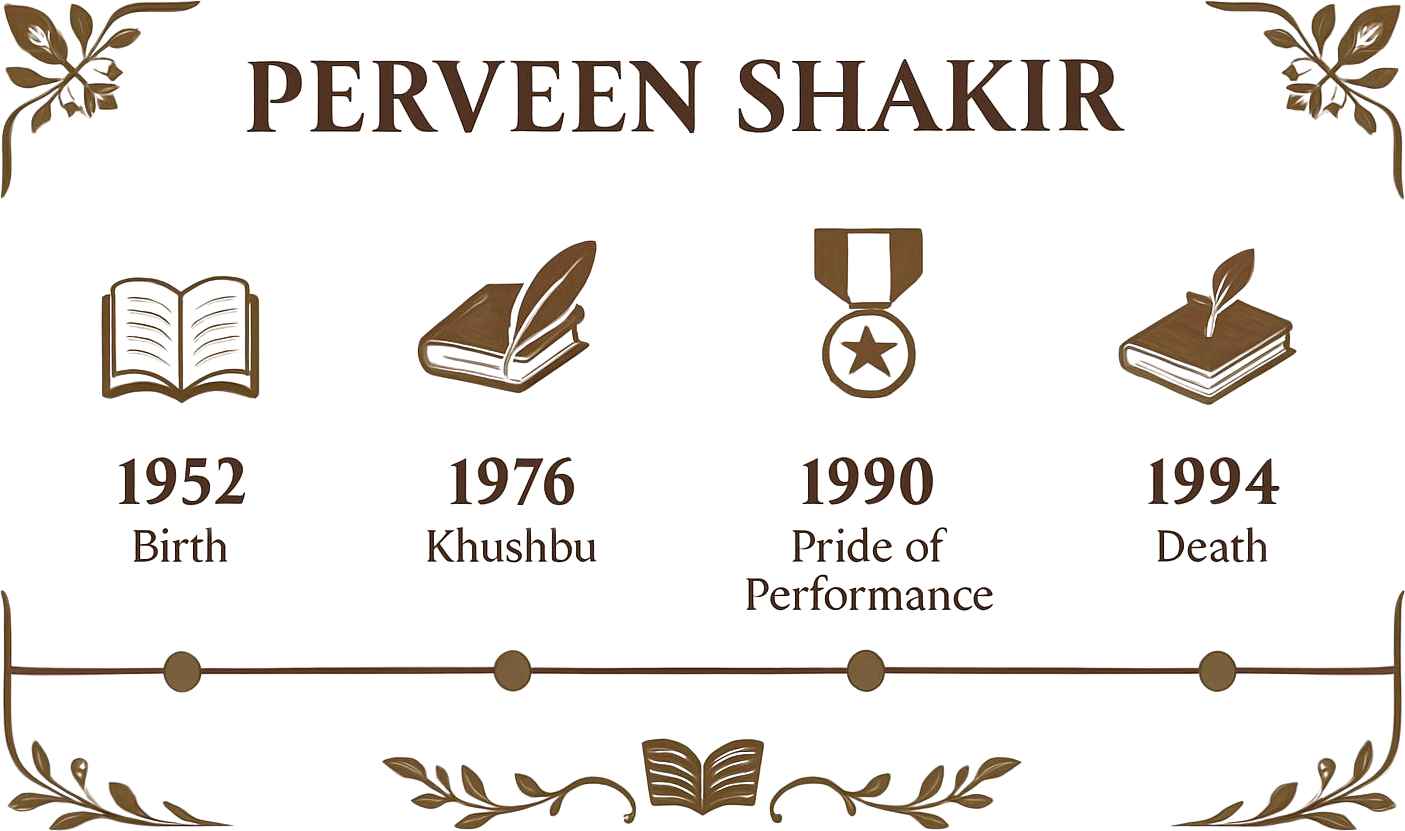
Parveen Shakir (1952–1994) was a Pakistani poet, educator, and civil servant who gave Urdu literature something it had been waiting for — a woman’s voice that did not apologize, soften itself into acceptability, or retreat behind metaphor to avoid saying what it actually meant. Her shayari spoke love directly, expressed longing without shame, and named feminine pain in a literary tradition that had mostly spoken about women, rarely as them.
She published six poetry collections in a life cut short at age 42 by a road accident in Islamabad. But those six books — and especially her debut, Khushbu — contain enough emotional truth to sustain readers for a lifetime. This is the complete guide to Parveen Shakir shayari in Urdu: her best verses, what they mean, why they matter, and where to go deeper.
Who Was Parveen Shakir — The Woman Behind the Words
Parveen Shakir was not just a poet — she was a quiet revolution in the history of Urdu literature. Born on November 24, 1952, in Karachi, into an Urdu-speaking middle-class family, she showed an unusual relationship with language from childhood. She was reading serious poetry before most children her age had finished their school readers. By the time she was a teenager, she was writing it.
She completed her early education at Sir Sayyid College, Karachi, then pursued postgraduate degrees in English literature and linguistics — a combination that would later give her shayari its distinctive dual elegance: the classical Urdu sensibility of a scholar and the emotional directness of someone who had clearly lived what she wrote. She eventually joined Pakistan’s civil service (CSS) and worked in the customs department — a life that felt, on the surface, completely ordinary. The extraordinary happened in her notebooks.
Her Pen Name and the Choice Behind It
She began writing under the pen name Beena — a word meaning “one who sees.” Later, she settled on Shakir — meaning “grateful.” Both names reveal something about her artistic self-understanding. She was a poet who saw clearly and felt deeply grateful for the ability to transform pain into language. That gratitude was genuine, not performative. You feel it in every line she wrote.
The Personal Pain That Shaped Her Poetry
Those who study her work carefully know that Parveen Shakir’s shayari was not abstract emotional exercise. Much of it was drawn directly from her own experience of love, loss, and a marriage that ended in separation. She raised her son largely alone. She wrote about waiting — not the romantic waiting of old ghazal tradition, but the specific, crushing waiting of a woman who knows the person she loves may not return. That specificity is part of what makes her Urdu poetry feel so different from anything written before her.
The Six Books — A Complete Map of Her Literary Universe
Each of Parveen Shakir’s six poetry collections marks a distinct emotional and artistic stage of her life, and understanding them together gives you the full arc of one of the most important voices in modern Urdu literature.
Her debut collection, Khushbu (Fragrance), published in 1976, arrived when she was just 24 years old. The literary world was not prepared for it. Khushbu won the Adamjee Literary Award and immediately established herself as a poet of serious weight. What made it remarkable was not just its quality but its courage — it spoke about love and desire from a woman’s first-person perspective with a clarity that Urdu ghazal tradition had rarely, if ever, seen. Male poets had written for centuries about the beloved — almost always a figure addressed in second person, shrouded in ambiguity. Parveen Shakir wrote as the lover herself.
The Evolution Through Her Collections
Sad-barg (Marsh Marigold), published in 1980, showed a more mature, more contemplative poet — one who had moved from the exhilaration of Khushbu into something quieter and more complex. Khud Kalami (Self-Talk) and Inkaar (Refusal), both published in 1990, represent perhaps her most politically and personally charged writing, work written under the shadow of Zia-ul-Haq’s conservative military regime, when the social freedoms of Pakistani women were being visibly compressed. Mah-e-Tamam (The Complete Moon) came in 1994, the year of her death. Kaf-e-Aina (The Edge of the Mirror), published posthumously, collected diary entries and journal fragments — an intimate, unfiltered look at the mind behind the shayari.
Reading her books in order is like watching a person become fully themselves — and then watching time run out.
If you want to explore her debut collection in detail, the guide on [Parveen Shakir Khushbu Poetry] covers every major theme and verse in depth.
Parveen Shakir’s Best Shayari in Urdu — Couplets That Changed How Urdu Poetry Sounds
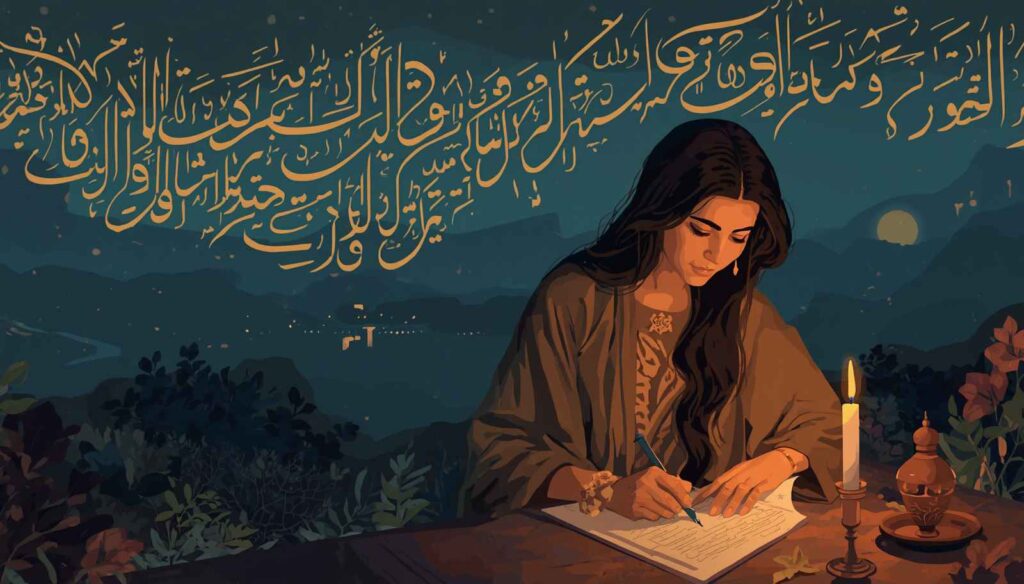
The best way to understand why Parveen Shakir’s shayari matters is to sit with her actual words — not summaries of them, but the verses themselves. Below are some of her most celebrated couplets, presented in Urdu script, Roman Urdu transliteration, and English meaning, because great poetry deserves to be understood at every level.
On Love That Transforms
وہ تو خوشبو ہے ہواؤں میں بکھر جائے گا مسئلہ پھول کا ہے پھول کدھر جائے گا
He is like fragrance — he will scatter into the wind. The question is about the flower. Where will the flower go?
This is among the most quoted lines in modern Urdu shayari, and for good reason. She reverses the conventional power dynamic of romantic poetry — the beloved (traditionally celebrated and exalted) is here the fragrance, temporary and dispersing. The speaker — the flower, the poet, the woman — is the one left behind, rootless. It’s a heartbreaking inversion of who matters, and it arrives in two lines.
On Waiting
تو بدلتا ہے تو بے ساختہ میری آنکھیں میرے ہاتھوں کی لکیروں سے الجھ جاتی ہیں
When you change, my eyes involuntarily get tangled in the lines of my own palms.
The imagery here is extraordinary. When the person she loves changes, she looks down at her own hands — at fate lines on her palms — as if searching for a reason, a sign, a clue that this was always going to happen. It’s a poet watching herself search for meaning in the wreckage.
On Self-Respect
Kaanton mein ghiray phool ko choom aaye gi lekin Titli ke paron ko kabhi chhalte nahi dekha
Parveen Shakir had a gift for nature imagery that never felt decorative. Here, the butterfly is not careless — it is graceful enough to love something dangerous without being destroyed. Whether she was speaking of herself, of women in general, or of the specific skill of surviving love, readers hear all three at once.
Parveen Shakir’s Ghazal Style — What Made Her Different From Every Poet Before Her
Parveen Shakir did not simply write ghazals — she reconstructed the ghazal from the inside, using its classical architecture to say things the form had never been used to say. The ghazal is one of the oldest forms in Urdu and Persian literature: a poem built on a consistent end-rhyme and refrain (radif), with each couplet (sher) standing independently. The final couplet (the maqta) traditionally includes the poet’s pen name. Parveen Shakir mastered all of this. And then she brought something entirely new to it.
The Feminine Pronoun as Revolutionary Act
In classical Urdu ghazal tradition, the grammatical gender of the speaker was deliberately kept ambiguous or defaulted to male. Parveen Shakir used unambiguously feminine grammar throughout her work. The Urdu language marks gender in verb conjugations and adjectives, so when she wrote herself as she, not he or neutral, every educated reader noticed. Recent literary scholarship confirms that this shift — simple grammatically, radical culturally — is one of her most significant contributions to Urdu literature. She was the first to do it consistently and unapologetically.
Her Use of Nature Imagery
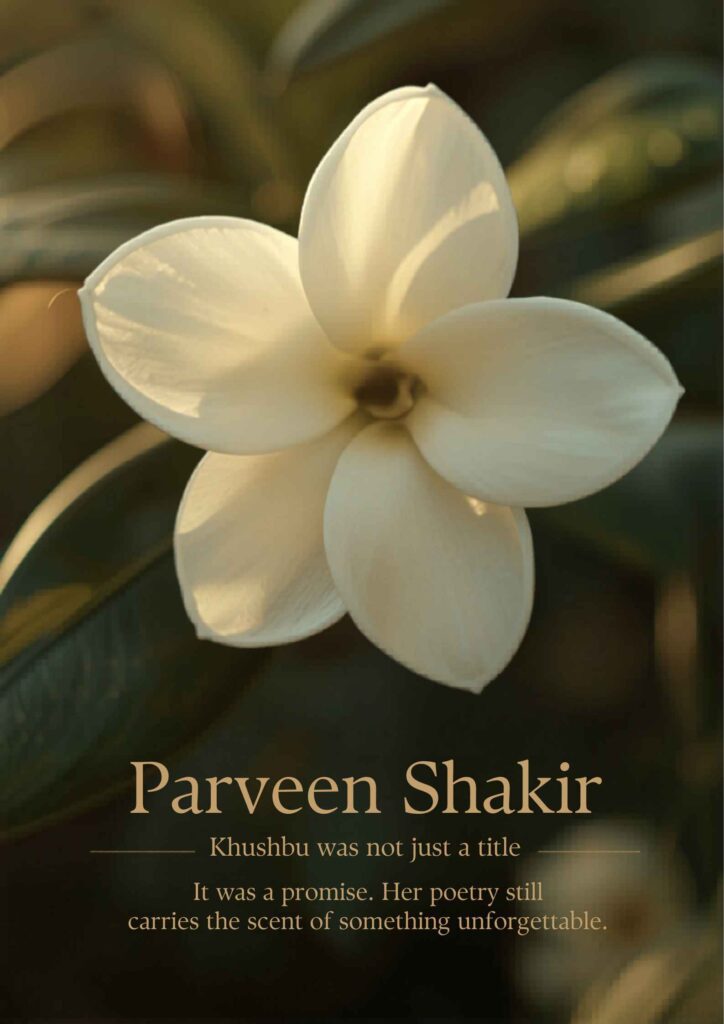
Khushbu — fragrance, the scent of flowers — runs through her work as both imagery and metaphor. She returned again and again to flowers, rain, the moon, butterflies, and seasons. But unlike decorative nature imagery in older Urdu poetry, her natural world always carried emotional weight. The flower is always in danger. The rain always arrives too late or too soon. The fragrance always belongs to something that has already scattered. Nature, in her hands, becomes a quiet language for what cannot be said directly.
Parveen Shakir Sad Shayari — Her Most Heart-Touching Lines on Loss and Longing
Parveen Shakir’s sad shayari is not melodramatic — it is precise. That precision is what separates it from ordinary dard shayari and elevates it into something that feels almost unbearable in its accuracy. She did not write general sadness. She wrote the specific sadness of a specific moment: the second after someone you love says something that tells you it is already over, the quiet of a house that used to have more voices in it, the strange normalcy of continuing to exist after loss.
Key Themes in Her Sad Poetry
Her sad shayari circles around a few recurring themes: the pain of loving someone who cannot stay, the weight of waiting that never ends, the loneliness of being misunderstood by the person closest to you, and the particular grief of watching yourself diminish in someone else’s eyes. What makes these themes hit so hard is that she never overexplains them. She trusts the image to carry the emotion, and that trust is almost always rewarded.
تھک گیا ہے دل وحشی مرا فریاد سے بھی جی بہلتا نہیں اے دوست تری یاد سے بھی
My restless heart has grown tired even of crying out. And I find no comfort, my friend, even in your memory.
This is a late-stage grief couplet — not fresh sorrow, but the exhaustion that sets in after fresh sorrow has passed and nothing has replaced it. Even the memory that once felt like company no longer brings relief. It is, quietly, one of the loneliest couplets in Urdu poetry.
Parveen Shakir Love Poetry — How She Wrote About Mohabbat Like No One Before Her
Parveen Shakir’s love poetry is the most widely shared, widely quoted, and widely felt part of her entire body of work — and it is not hard to understand why. She wrote mohabbat shayari with a combination of vulnerability and clarity that feels almost impossible to achieve. Love poetry, done badly, becomes either saccharine or self-pitying. Done at her level, it becomes a mirror.
Her romantic poetry works because she refused to idealize love while still believing in it completely. She wrote about love’s joy with equal honesty to love’s pain. She wrote about desire — something female Urdu poets before her rarely addressed directly — with dignity and grace. And she wrote about the aftermath of love, the hollow aftermath, with a specificity that makes readers catch their breath.
Love as Both Gift and Weight
What she understood — and what most love poetry fails to capture — is that love does not simplify a person. It complicates them. It makes you more aware of everything you want and everything you fear losing. Her love shayari sits inside that complexity rather than trying to resolve it. That is why her romantic verses feel like honest company rather than empty comfort.
Why Parveen Shakir’s Poetry Matters to the South Asian Diaspora in the USA
For millions of South Asian Americans, Parveen Shakir’s shayari is not just literature — it is a form of cultural memory that keeps identity intact across distance. As of today, the South Asian diaspora in the United States numbers over five million people. Many grew up speaking Urdu or Hindi at home and English everywhere else. They carry two languages and, with them, two emotional registers. Parveen Shakir lives in the space between those two worlds.
Her poetry is accessible — the language is modern, not archaic. Her themes are universal — love, loss, dignity, the complexity of being a feeling person in a world that often doesn’t reward feeling. And her voice is distinctly South Asian in a way that cannot be replicated in English translation. Reading her in the original Urdu is, for diaspora readers, an act of reclamation. It is remembering that your mother tongue was always capable of this.
Recent literary research suggests that her work is increasingly taught in South Asian studies programs at American universities precisely because she bridges classical Urdu tradition and modern feminist thought, making her ideal for academic contexts that want both.
Parveen Shakir’s Literary Legacy — 30 Years Later, Her Words Only Grow
Parveen Shakir died in a road accident on December 26, 1994, in Islamabad. She was 42 years old. The accident was sudden, the loss immediate, and the literary world — already knowing, even then, what she was — went quiet for a moment that has never quite ended.
Thirty years later, we know her impact cannot be measured by awards or academic citations alone, though she has those, too. The Pride of Performance award, Pakistan’s highest civil honor, was given to her in 1990. Her books have never gone out of print. An annual literary festival in Islamabad commemorates her legacy. And every single day, her couplets are shared across Instagram, WhatsApp, Facebook, and X by people who may not know her biography but feel, in her words, that someone finally understood something true.
What the Next Generation Found in Her Work
There is something counterintuitive worth noting here: younger readers — particularly those between 18 and 30 who are coming to Urdu poetry for the first time — often discover Parveen Shakir before they discover Ghalib or Faiz. This says something about the accessibility of her language, yes. But it also says something about what this generation needs. They need poetry that is honest about pain without romanticizing it, that speaks about love without promising it will be easy, and that holds space for feminine experience without framing it as exceptional or unusual. She delivers all of that—every single time.
FAQ Section
Q1: What is Parveen Shakir most famous for?
Parveen Shakir is most famous for introducing a distinctly feminine first-person voice into Urdu ghazal poetry. Her debut collection, Khushbu (1976), is considered one of the most significant works in modern Urdu literature. She is celebrated for her emotional depth, lyrical precision, and the courage to write about love, desire, and women’s inner experience with unprecedented directness.
Q2: How many poetry books did Parveen Shakir write?
She published six poetry collections: Khushbu (1976), Sad-barg (1980), Khud Kalami (1990), Inkaar (1990), Mah-e-Tamam (1994), and the posthumous Kaf-e-Aina. Her newspaper columns were also compiled in Gosha-e-Chashm. Each collection represents a distinct emotional and artistic phase of her relatively short but extraordinarily rich literary life.
Q3: What language did Parveen Shakir write in?
She wrote primarily in Urdu, with deep roots in the classical Persian-influenced ghazal tradition. Her language was notably modern and accessible compared to classical Urdu poets — she chose words that preserved poetic beauty while remaining clear enough to be felt immediately, without specialized literary knowledge. This accessibility is a major reason her work continues to reach new audiences.
Q4: What awards did Parveen Shakir receive?
She received the Adamjee Literary Award for her debut collection Khushbu and Pakistan’s prestigious Pride of Performance award in 1990 — one of the country’s highest civil honors. After her death, the Pakistan Post Office issued a commemorative postage stamp in her honor on her nineteenth death anniversary.
Q5: How can someone new to Urdu poetry start reading Parveen Shakir?
The best entry point is Khushbu, her debut collection — it is the most emotionally accessible and contains many of her most beloved couplets. If reading in Urdu script feels challenging, look for editions that include Roman Urdu transliteration or English translations alongside the original. Start with two-line shayari (dohe) before moving to full ghazals. The emotional truth in her work transcends any language barrier.
Q6: Was Parveen Shakir a feminist poet?
While she did not always use the word feminist to describe herself, her work is deeply feminist in practice. She consistently wrote from a woman’s perspective using unambiguous feminine grammar in a tradition that had long defaulted to male viewpoints. She addressed desire, longing, self-respect, and emotional autonomy in ways that challenged the conservative literary norms of her time — and of the political environment under Zia-ul-Haq’s regime. Contemporary literary scholars widely categorize her as one of Pakistan’s most significant feminist literary voices.
Conclusion — A Poet Who Will Not Be Forgotten
Parveen Shakir wrote in a language that some call difficult, in a tradition that some call esoteric, during a time that some call distant. None of that has slowed her down. Her shayari continues to travel — from Karachi to California, from 1976 to 2025, from printed page to glowing screen at midnight. She gave Urdu literature something it did not know it was missing: a woman who looked directly at the camera and refused to blink. Her words are the record of that refusal. And as long as people carry love and longing and the need to be understood, her shayari in Urdu will remain exactly what it always was — not just poetry, but proof.