
Introduction:
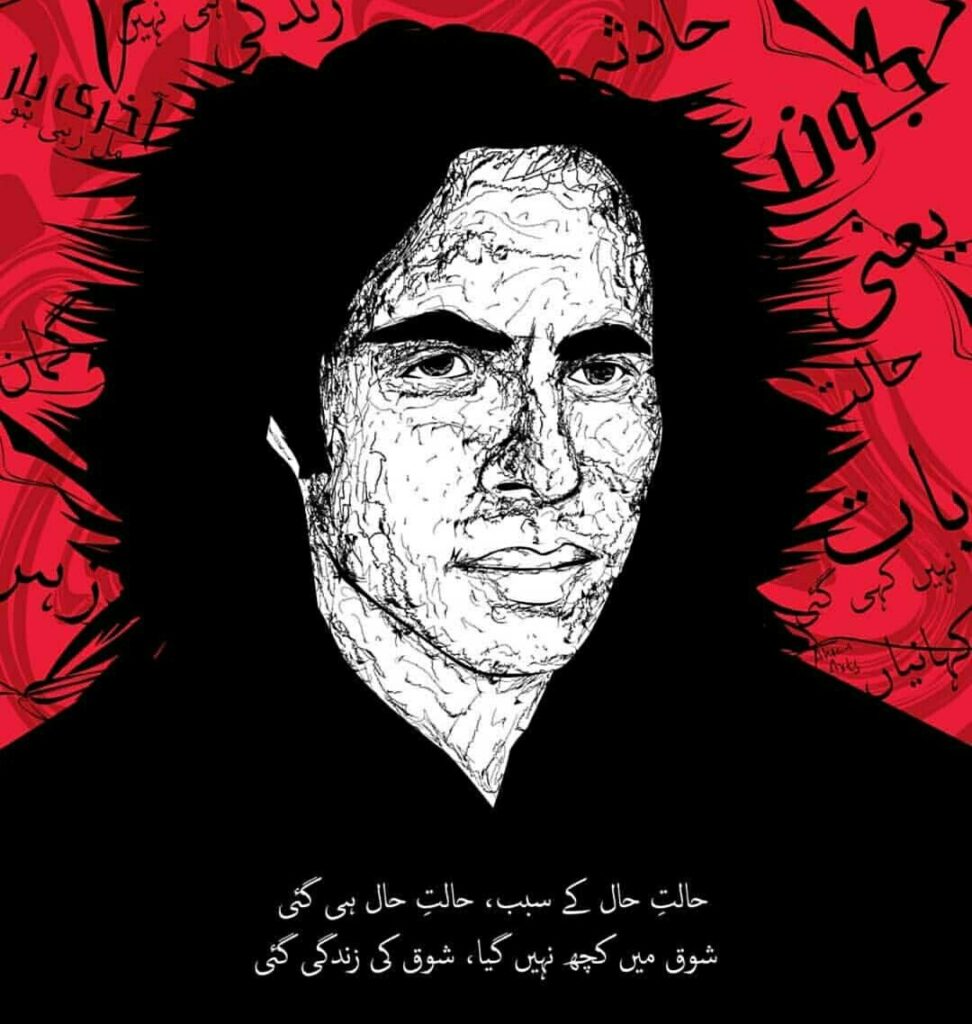
The world of Urdu literature is vast, yet few figures loom as large or as hauntingly as Jaun Elia. He wasn’t merely a poet — he was a phenomenon, a scholar-rebel who wore his heartbreak openly and his intellect like a weapon. Fluent in Urdu, Persian, Arabic, and English, he brought a rare scholarly depth to verses that still read as simple and aching on the surface, blending nihilism, self-doubt, and quiet philosophy into some of modern Urdu poetry’s most quoted lines.
To understand the modern landscape of South Asian poetry, it genuinely helps to understand the man who turned personal pain into something closer to a philosophy than a passing mood. This article covers his early life in Amroha, the migration that shaped his later work, his major published collections, and why his poetry continues to resonate with readers decades after he died in 2002.
The Scholar Who Found Comfort in Chaos
Jaun Elia, whose full name was Syed Sibt-e-Asghar Naqvi, was born in Amroha, British India, on December 14, 1931. He came from a family of intellectuals, though while many of his peers stayed close to the strict rhythmic structures of classical ghazal, Jaun was busy dismantling the poet’s usual sense of self-importance instead.
He was fluent in Urdu, Persian, Arabic, and English, and this scholarly range let him weave ideas from Sufism, philosophy, and existential thought into verses that still read as simple and aching on the surface. Reading Jaun isn’t just reading poetry — it often feels closer to watching a scholar work through the futility of existence in real time.
What Set Jaun Apart From His Peers
This sub-section covers what set Jaun apart from poets working in a similar tradition, since his reputation as a “rebel” can sound vague without specifics.
Jaun Elia’s nihilism runs through much of his work. Where many of his contemporaries wrote about the beauty of the rose and the nightingale, Jaun tended to focus on the rot underneath the garden instead. His honesty about emptiness, doubt, and self-deception was unusual for the era he was writing in, particularly in a literary culture that often expected poets to perform devotion rather than admit to its absence.
Why His Honesty Stood Out
This sub-section explains what made this honesty stand out at the time, rather than simply asserting that it did.
In an era where romantic poetry often leaned toward performance, Jaun’s willingness to admit confusion and emotional emptiness set him apart from poets writing about idealized love. He wasn’t positioning himself as the wronged lover in the traditional sense — his verses more often examined his own inability to fully belong anywhere, including within his own relationships.
Why Jaun Elia Resonates With Younger Readers
Jaun Elia has seen a significant resurgence among younger readers in the digital age, and there are a few clear reasons why his work resonates with a modern audience specifically.

The Reasons Behind the Resurgence
His migration from Amroha to Karachi around the time of Partition in 1947 left a lasting mark on his work, and that sense of displacement speaks directly to readers who’ve experienced their own version of leaving somewhere permanently. He was also openly critical of religious and political hypocrisy, which gives his work an anti-establishment edge that still lands with younger audiences. And perhaps most importantly, he showed that it was acceptable for a man to appear shattered and unresolved in his writing, at a time when that kind of vulnerability wasn’t common in published poetry.
Key Literary Works
Jaun Elia’s major published works reflect different stages of his thinking and life.
| Book | Theme | Notes |
| Shayad | Doubt and existence | His first and most widely read collection |
| Yaani | Relational pain | A closer look at the self within relationships |
| Gumaan | Illusion | Focused on the fragility of perceived reality |
| Lekin | Reflection | Later work, more contemplative in tone |
The Amroha Connection: A Lost Paradise
To Jaun Elia, Amroha wasn’t just the city where he was born — it represented an entire lost era of innocence that he kept returning to throughout his writing. His poetry frequently circles back to streets and memories from his childhood there, and this sense of exile, or ghorbat, is one of the most consistent themes running through his work.

How Deeply the Displacement Shaped Him
This sub-section addresses how strongly Jaun felt this displacement, since it shaped so much of what he later wrote.
He reportedly described leaving Amroha in deeply personal terms, framing the move less as a simple relocation and more as a rupture in his sense of identity. Whatever the exact wording he used at different points, the underlying sentiment is well documented across his poetry: Karachi never fully replaced what Amroha represented to him, and that unresolved loss shaped much of his later, more bitter verse.
The Performance: The Art of Mushaira
To really understand Jaun Elia’s impact, it helps to know what he was like performing live, not just on the page.
His Style at Mushairas
This sub-section describes his specific performance style at mushairas, since it’s a significant part of why his reputation extended beyond readers of his printed books.
His style at mushairas (poetry gatherings) was notably unconventional for the time — he’d often appear visibly disheveled, gesture dramatically, and deliver his verses with an intensity that read as genuinely unrehearsed rather than staged for effect. This wasn’t a calculated performance choice so much as an outward expression of his internal state. In doing so, he became one of the first Urdu poets whose public persona felt closer to a rock performer than to the reserved, formal demeanor typically associated with classical mushaira poets. He brought a kind of controlled chaos to literary circles in Karachi that hadn’t quite been seen in that form before.
Jaun Elia’s Relationship With His Family
Jaun Elia came from a household where intellectual pursuits were taken seriously, and understanding that background helps explain why his work carries the scholarly depth it does, even when the surface language stays simple.

His Family’s Intellectual Environment
Growing up in a family with strong literary and religious scholarship traditions gave Jaun early access to classical Arabic and Persian texts, which later fed directly into his poetry’s philosophical range. This wasn’t a case of a poet discovering deep texts later in life — the exposure came early and shaped how naturally he could move between colloquial Urdu and denser philosophical ideas within the same verse.
Why “Shayad” Still Defines His Legacy
Jaun Elia’s debut collection, Shayad, wasn’t published until relatively late in his life, decades after he’d already written much of the material inside it — a detail that surprises many readers encountering his biography for the first time.
Why the Delayed Publication Matters
Because Shayad collected work written across a long span of time rather than representing a single creative period, it reads less like a debut and more like a retrospective of decades of private writing finally made public. That gap between writing and publishing is part of why the collection feels so fully formed — it wasn’t rushed out to establish an early reputation, and by the time it appeared, Jaun’s voice was already fully developed.
How Jaun Elia Is Remembered Today
Decades after his death, Jaun Elia’s verses circulate constantly on social media, often stripped of context and shared as standalone lines about heartbreak or nihilism.
A Common Issue With How His Work Gets Consumed Now
Because individual couplets travel easily online, it’s common to encounter a single striking line from Jaun without any sense of the larger poem or emotional argument it belongs to. His work often builds an idea slowly across several verses, and reading only the most quotable line can flatten the more complicated, self-aware philosophy underneath it.
Jaun Elia’s Influence on Contemporary Urdu Poets
Jaun Elia’s impact extends well beyond his own published work — a generation of younger Urdu poets and spoken-word artists cite him directly as the reason they started taking confessional, less formally structured poetry seriously.
How His Influence Shows Up in Newer Poetry
Younger poets often point to Jaun’s willingness to write in a conversational register — using everyday phrasing rather than the more ornate vocabulary common in classical ghazal — as permission to do the same in their own work.
FAQs
What is Jaun Elia’s most famous book?
His first collection, Shayad (meaning “Perhaps”), remains his most widely read and discussed work. Its preface is also frequently cited as a notable piece of Urdu prose in its own right.
Why is Jaun Elia often described as a nihilist?
He’s described this way because a large portion of his work focuses on the meaninglessness and futility of existence, and he was openly skeptical of traditional moral and social structures.
Did Jaun Elia write in languages other than Urdu?
Yes — he was fluent in Persian, Arabic, and English as well, and translated several Arabic and Persian texts into Urdu.
When did Jaun Elia migrate from Amroha to Karachi?
He left Amroha around the time of Partition in 1947 — not 1957, a date that circulates incorrectly on some other sites.
What made Jaun Elia’s performance style at mushairas unusual?
Unlike the more composed, formal delivery typical of mushaira poets at the time, Jaun performed with visible emotional intensity that came across as genuine rather than staged.
Was Jaun Elia related to other well-known writers?
He came from a family with a notable literary and scholarly background, which shaped his early exposure to classical texts and languages well before he began writing seriously himself.
Why was Shayad published so much later than when Jaun actually wrote most of it?
Much of the material had been written over decades, and Jaun was famously reluctant to formally publish his work.
Is Jaun Elia considered part of the classical Urdu poetry tradition, or something separate from it?
He’s usually treated as a transitional figure — deeply read in classical forms and philosophy, but writing in a way that pushed against the formal expectations of that same tradition.
Final Thoughts
Jaun Elia’s work still resonates because he refused to perform certainty he didn’t feel, at a time when that kind of honesty wasn’t the norm in published poetry. Whether read for the philosophy, the raw emotional honesty, or the unconventional performance style behind it, his work rewards a slow, attentive read rather than a quick skim for quotable lines pulled out of context.