
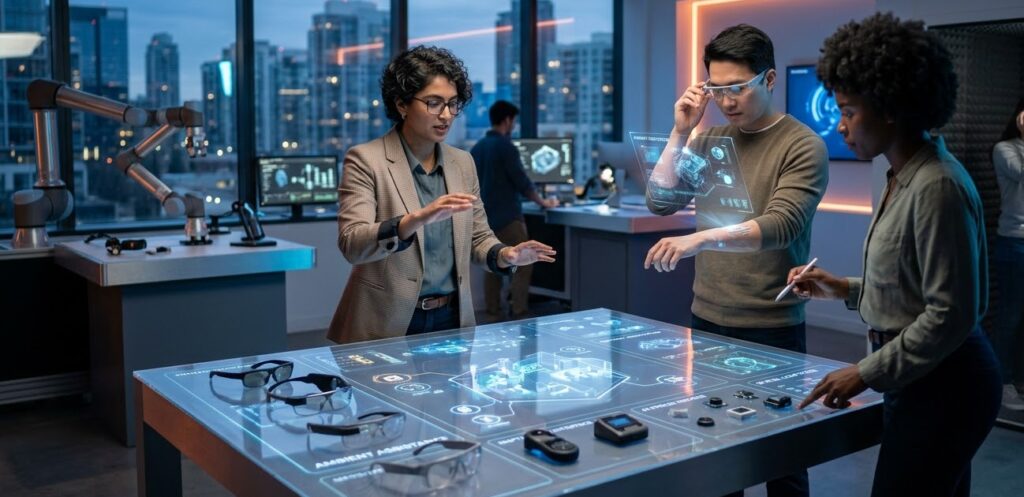
Please understand that the glass slab in your pocket is no longer the final frontier. For over a decade, the smartphone has been our digital sun. However, as we move through 2026, the gravity is shifting. Today, tech giants envision a future beyond smartphones as an invisible ecosystem. This intelligence follows you instead of demanding your constant attention.
Future Beyond Smartphones: The End of the Screen Era
We have reached “peak smartphone” today. Innovation in mobile hardware has hit a plateau. Specifically, we see only minor upgrades in chips and cameras. Consequently, the true disruption is happening in how we interact with data.
When we say tech giants envision a future beyond smartphones, we mean a shift toward “ambient computing.” In this world, technology anticipates your needs silently. Therefore, companies like Meta and Apple are betting billions on hands-free devices. They want us to keep our heads up while staying connected.
1. AI Hardware and the Future Beyond Smartphones
One major shift involves AI-native hardware. For example, the collaboration between Sam Altman and Jony Ive is a top story for 2026. Unlike older phones, this device is screenless and “peaceful.” It uses large language models to act as a digital concierge.
Moreover, this pocket-sized companion won’t distract you with pings. Instead, it filters the world for you in real-time. This is a core reason why tech giants envision a future beyond smartphones. They want to move away from the chaos of apps toward calm, AI-driven interfaces.
2. Spatial Computing: A Vision Beyond Smartphones
Apple’s Vision Pro was just the beginning. By mid-2026, the industry will pivot toward lightweight AR glasses. These are not bulky headsets. Rather, they are stylish frames that overlay data onto the physical world.
Furthermore, these glasses offer contextual navigation. Instead of looking at a small screen, your glasses highlight the path on the sidewalk. Additionally, you can project virtual workspaces onto any table. This proves that tech giants envision a future beyond smartphones by turning the entire world into a display.
3. Wearable Tech in the Future Beyond Smartphones
The early failures of AI pins provided a blueprint for success in 2026. Now, smart rings have matured into essential hubs. In this new era, your “phone” is distributed across your body.
-
Smart Buds: These handle real-time translation and voice queries.
-
Smart Rings: These track biometrics and allow air-gesture controls.
-
Smart Pins: These act as your eyes and identify objects.
Consequently, your interaction with the web becomes more natural. This distributed hardware is a key part of how tech giants envision a future beyond smartphones.
4. The Final Frontier: Brain Interfaces
While adoption is early, brain-computer interfaces (BCIs) are moving fast. Neuralink’s progress in 2025 has created a viable roadmap for the 2030s. The goal here is “Telepathy-as-a-Service.”
Ultimately, tech giants envision a future beyond smartphones where the lag between thought and action disappears. Controlling your environment with a thought is the ultimate endgame. It represents the final step in human-machine synergy.
Why the Post-Smartphone Shift Matters
This transition will not happen overnight. Thus, you won’t discard your phone immediately. Instead, you will simply reach for it less often. You will answer texts via your glasses. You will check your pulse via your ring. Finally, your AI agent will book your flights while you walk.
As tech giants envision a future beyond smartphones, the focus shifts from consuming content to living with intelligence. We are moving toward a world where technology is finally becoming invisible.
Frequently Asked Questions
Will smartphones disappear by 2030?
Not entirely. While tech giants envision a future beyond smartphones, the “slab” remains useful for high-end photography. However, for daily tasks, wearables will soon take over.
Is this future safe for my privacy?
This is a major hurdle. With “always-on” cameras, privacy rules are being rewritten in 2026. To protect you, companies are moving toward on-device processing.
What is the most likely successor to the iPhone?
There isn’t one single successor. Rather, a “constellation” of devices will replace it. Specifically, AR glasses and AI rings will handle most of your digital needs.